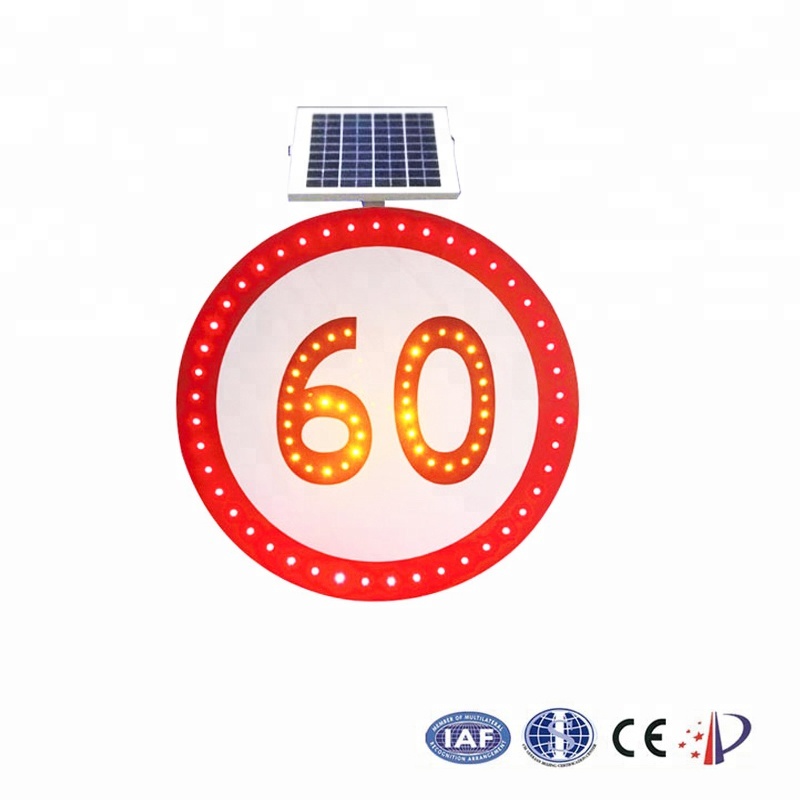
Focus on manufacturing: traffic signs, solar traffic signs, solar radar speed displays, solar traffic warning lights, solar road studs

Products

Xiangxu Traffic has spent more than 12 years developing traffic safety facilities products with high quality and competitive prices. Each solar series product has corresponding product design, manufacturing, testing, installation, shipping and other services, which can also save a lot of time and cost.
From product accessories to the entire product, we provide the highest quality products. As a professional manufacturer of traffic safety facilities products, we mainly supply five series of products, namely solar LED traffic signs, solar radar speed feedback signs, solar yellow flashing lights, normal aluminum traffic signs and other traffic safety products.
So far, Xiangxu Traffic has obtained several utility model patent certificates for its modern design. Customized products can also be manufactured. OEM & ODM are welcomed.

We offer municipal grade, professional traffic signs that do not rust and can easily withstand harsh weather conditions for many years.  We do accept government purchase orders.  No order is too big or small
We proudly serve the traffic sign needs of states, counties, cities, towns, villages, road districts, businesses, shopping centers, construction companies, hospitals, schools, mobile home parks, golf courses, airports, homeowner associations
  • Regulatory Signs
  • Warning Signs
  • Street Signs
  • Custom Traffic Signs
  • Mounting Hardware
  • Reflective Traffic signs
  • Stop Signs
  • Speed Limit Signs
  • Parking Signs
  • Construction Signs
  • School Signs
  • Custom Parking Signs
  • Sign Posts
  • Handicapped Signs
  • Yield Signs
  • Metal Traffic
Traffic Sign Materials Guide
Engineer Grade

Engineer Grade Reflective Sheeting for Traffic Signs 3m
High Intensity

Prismatic
High Intensity Prismatic Film for Traffic Signs 3M
Diamond Grade

Diamond Grade Reflective Sheeting for Traffic Signs 3M
 
Science of Retroreflectivity
 
Retroreflective signs help address nighttime driving safety issues such as older drivers, glare, visual clues and driver expectations. Upcoming MUTCD standards are structured around basics of sheeting retroreflectivity. The fundamental question was how to relate “standard retroreflectivity” to visibility of traffic signs:
 
 
Lighting parameters …
Headlights emit light measured in candelas (intensity [cd]) When the beam from a headlight strikes the sign surface, the amount of light meeting the surface is measured in lux (illuminance) When this light is reflected toward an observer, the observer sees brightness, or luminance, measured in candelas per meter squared (cd/m2) Coefficient of retroreflection is the ratio of this luminance or brightness to the illuminance (RA = cd/m2/lux)
 
Retroreflection: A special type of reflection where incoming light is returned toward its source.
 
Entrance Angle: This is a measure of how the light is entering the sign. If the light is entering the surface perpendicularly, the entrance angle is zero. Observation Angle: This is the angle between the illumination path (from a headlight to the sign) and the observation path (from driver eye to the sign). In a sense, it is the measure of separation of the driver’s viewpoint from a headlight.
 
Coefficient of retroreflection (RA) is a measure of retroreflective efficiency of a retroreflector at a specific set of entrance angle and observation angle, which specifies one certain viewing geometry. Minimum retroreflectivity requirements refer strictly to 0.2 degree observation angle and -4 degree entrance angle. Retroreflective efficiency: The percent of light returned back toward its source by a retroreflector. Typically, beaded sheetings have 7% to 14%, truncated cube microprismatic sheetings have about 32%, and a full-cube sheeting has 58% retroreflective efficiency. There is no direct correlation between the retroreflective efficiency and ASTM sheeting types.
 
15 Traffic sign retroreflectivity “sign retro 101”, FHWA Visibility Team PowerPoint
 
Owners or parties responsible for such private roads have two years from the date of the ruling (January 17, 2007) to bring traffic control devices into compliance with the MUTCD and other applicable State Manuals.
 

ALUMINUM ALLOY 3105

Characteristics

3105 is an essentially 98% pure aluminum alloy with minor additions for strength. It is not hardenable by heat treatment, and has excellent formability, corrosion resistance and welding characteristics.


Typical Applications

3105 is commonly used for building products.


ALUMINUM ALLOY 5052

Characteristics

5052 is one of the higher strength non-heat-treatable alloys. It has a high fatigue strength and excellent corrosion resistance, particularly in marine atmospheres. The form-ability of the grade is excellent and in the annealed condition it offers higher strengths than 1100 or 3003 grades. One of the most popular alloys.


Typical Applications

5052 is often used in high strength sheet metal work, marine components, appliances, fuel and oil tubing, signs, trucks bodies and electrical cabinets.